
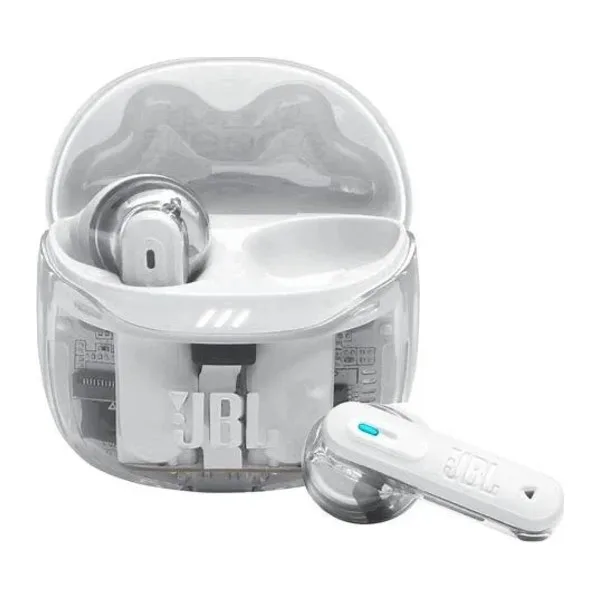
JBL Tune Flex 2 True Wireless Earbuds – Adaptive Noise Cancelling, Spatial Sound & 48-Hour Battery Life
Klarna.Or 3 payments of €33.33 with Klarna.
humm
- Free 15-day returnsUnopened, sealed items only
- Fast deliveryOr collect in store
Bought with confidence.
Bray, Ballina and Sligo. Collect, get help setting up, or bring it in for a repair.
Return it unopened, in its original sealed packaging, within 15 days for a full refund.
1-2 working days. Or click & collect for free.
JBL Tune Flex 2 True Wireless Earbuds – Adaptive Noise Cancelling, Spatial Sound & 48-Hour Battery Life
Forty-eight hours of total battery life in a pair of true wireless earbuds sounds like marketing overstatement until you actually live with it. With the JBL Tune Flex 2, the combination of the earbuds themselves and the smart charging case genuinely gets you through multiple days of regular use without reaching for a cable. For anyone who has ever arrived at work, a gym, or an airport with dead earbuds because they forgot to charge them the night before, that number becomes very meaningful very quickly.
The spatial sound technology is what separates the Tune Flex 2 from earbuds at a similar price point. Rather than delivering a flat stereo image directly into your ears, spatial sound creates a sense of three-dimensional space around the music—like the difference between watching something on a laptop screen versus a cinema. For streaming films and series, it's particularly effective, placing dialogue, effects, and music in distinct positions that feel natural and immersive. For music, it opens up the soundstage in a way that feels more like listening through speakers than earbuds.
The adaptive noise cancellation works in both directions — it reduces unwanted external noise when you want to focus, and it can shift into a transparency mode that lets in the sounds you actually need to hear, like traffic, announcements, or a conversation. This dual capability makes the Tune Flex 2 genuinely versatile rather than just useful in quiet environments. The open-ear design adds another layer of comfort, making extended listening sessions easy on both your ears and your ear canals.
JBL has put meaningful thought into what it actually means to use earbuds every day, and the Tune Flex 2 reflects that. The touch controls work reliably, the connection to your phone is stable across the Bluetooth 5.3 standard, and the JBL Headphones app gives you real control over the sound and settings rather than just a logo and a firmware update button. These are earbuds built for people who listen to a lot of content and want something that keeps up without constant management — and on that measure, they deliver.
Frequently Asked Questions
It is possible to customize it via the JBL Headphones application.
Delivery & collectionFree delivery or collect in store
- Click & collect in store — Ready same day. Free
- An Post tracked — 1-2 working days. Free
- DPD next day — Next working day if ordered before 1pm. €12.99
- Click and collect — free from Bray, Ballina, Sligo.
Prices include VAT.
15-day returnsUnopened items
Changed your mind? You can return it within 15 days for a full refund as long as it is unopened, in its original sealed packaging. Premium-grade phones and accessories can’t be returned once opened (this doesn’t affect your warranty or your rights if it’s faulty).
The details.
- Model
- JBL Tune Flex 2
- Type
- Open-Ear True Wireless Earbuds
- Driver Size
- 12mm
- Frequency response
- 20Hz – 20,000Hz
- Bluetooth Version
- 5.3
- Bluetooth Profiles
- A2DP, AVRCP, HFP, HSP
- Bluetooth Range
- Up to 10m
- Noise Cancellation
- Yes — Adaptive ANC
- Transparency Mode
- Yes
- Spatial Sound
- Yes — JBL Spatial Sound
- Microphone
- 4-mic array
- Battery Life
- Up to 12 hours (ANC off) / 9 hours (ANC on)
- Total Battery
- With Case: Up to 48 hours (ANC off) / 36 hours (ANC on)
- Charging Case Battery
- Smart Charging Case
- Quick charge
- 10 min charge = 2 hours playback
- Charging
- USB-C
- Water Resistance
- IPX5 (earbuds)
- Touch Controls
- Yes — customisable
- App Support
- JBL Headphones App (iOS & Android)
- Voice assistant
- Google Assistant / Siri
- Multipoint Connection
- Yes
- Weight
- 6.8g (per earbud)
- Colour
- White
- Condition
- New
- Available at
- fone4u.ie · Bray · Ballina · Sligo
Great service.got me back on track again. Thank you. Highly recommended
Great service. Were happy to diagnose an issue with my brand new S26 with no obligation. Eventually got it fixed, quick and efficient. Would definitely use again
Great service Very Pleased with everything Highly Recommended
What each condition means
Every phone is fully tested and unlocked. Only the look is different.
Looks and works like new. No visible scratches or marks on the screen or body when held at arm’s length. Fully tested and unlocked. Returnable within 15 days only if unopened.
Not for this modelVery light signs of use, like tiny scratches you’ll only spot up close. The screen looks perfect when switched on. Fully tested and unlocked.
Not for this modelVisible marks or light scratches from normal use. They don’t affect how it works. Fully tested, unlocked and our best value.
Not for this modelBrand new and unused, in original packaging.
Not for this model