
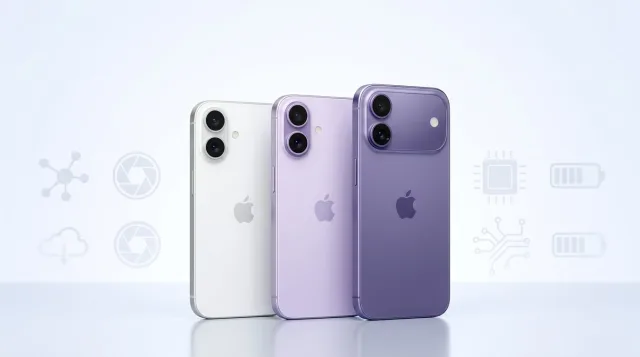
Here's a problem nobody had ten years ago: Apple currently has three full, genuinely good iPhone generations available at once. There's the iPhone 16 series, now sitting at a proper discount. There's the iPhone 17 lineup, a year old and still excellent. And there's the brand-new iPhone 18 Pro, Pro Max, and Fold, fresh off the stage from September's "Surprise and Shine" event.
That's a good problem to have as a shopper, but it does mean the question "which iPhone should I buy" doesn't have one answer anymore. It has a few honest follow-up questions. So let's actually work through them, rather than just listing specs for you.
The First Question Isn't "Which iPhone"—It"'s "Why Are You Upgrading?"
Most people land for one of three reasons, and it's worth being honest with yourself about which one you're in before you look at a single spec sheet.
- You're buying on budget — your current phone still basically works, but it's old enough that battery life or storage has become a daily annoyance, and you want the best phone for the least money. If that's you, skip ahead to the iPhone 16 section. Don't overthink this one.
- You're buying on features — you know exactly what you want more of, usually camera quality, chip performance, or screen size, and you're willing to pay for it. That's really a choice between the iPhone 17 Pro and the iPhone 18 Pro, and it's closer than you'd think.
- You're buying on timing — you already own a recent iPhone, and you're just trying to figure out if this is the year to trade up or the year to sit tight. That one deserves its own section too, further down.
If You're Buying on Budget: The iPhone 16 Series
This is the easiest recommendation in this whole guide. Since the iPhone 18 launch, pricing across the entire iPhone 16 lineup—the 16e, 16, 16 Plus, 16 Pro, and 16 Pro Max—dropped, and none of these phones feel like a downgrade in the ways that actually matter day to day. They run current iOS software. Every single model, including the budget-tier 16e, supports full Apple Intelligence. You're not buying yesterday's phone here; you're buying this year's software on last year's hardware, at a meaningfully lower price.
What you're giving up is mostly camera and chip refinement—nothing that shows up in messaging, browsing, or everyday photos, and plenty that only matters if you're a heavy photographer or gamer.
Full iPhone 16 series breakdown, pricing, and buying checklist →
If You're Buying on Features: iPhone 17 Pro vs. iPhone 18 Pro
This is the comparison people actually agonize over, so it deserves real attention instead of a one-liner.
The iPhone 17 Pro is, honestly, still a genuinely serious camera phone. Three matching 48MP lenses, a 120Hz ProMotion display, an A19 Pro chip that has no trouble with anything you throw at it. A year after launch, none of that has quietly become mediocre. It's simply a generation behind the newest thing, which is a very different problem than being outdated.
The iPhone 18 Pro's real advantage isn't marginal — it's the variable-aperture camera, genuinely new hardware that lets the lens physically adjust how much light it lets in, something no iPhone has ever had before. Pair that with the A20 Pro's 2-nanometer chip (a real manufacturing leap, not just a bigger number on a spec sheet), and you've got the first "worth the wait" iPhone upgrade in a few years, if photography or sustained performance under heavy use is actually why you buy Pro phones in the first place.
If none of that specifically excites you, the iPhone 17 Pro is not a consolation prize. It's simply the smarter buy at a lower price.
Full iPhone 17 lineup guide and upgrade decision →
Full breakdown of what's new in the iPhone 18 Pro, Pro Max, and Fold →
If You Already Own an iPhone: Should You Trade Up This Year?
Here's the thing about trade-in timing that most guides don't say plainly: your phone is worth the most right now, in the weeks immediately after a new launch, and it only goes down from here. That's not a sales tactic; it's just how the used market works—demand for last year's model softens the moment this year's model exists.
That doesn't mean you should trade up. If your current iPhone still does everything you need, there's no prize for upgrading on schedule. But if you've been on the fence, the financial case for deciding now rather than in six months is a real one, not an artificial deadline.
A Word on the iPhone Fold, Because Everyone's Asking
Apple's first foldable phone is genuinely new territory, and it deserves a slightly different kind of advice than the rest of this guide. Other manufacturers spent a few product generations working out foldable hinge durability and screen-crease visibility before those phones felt fully mature. Apple had the advantage of watching all of that happen first, but that doesn't mean its first attempt is automatically flawless—we simply don't have years of real-world daily use to point to yet, the way we do with the aluminum unibody Pro models.
If being first matters more to you than being certain, there's nothing wrong with that. If you'd rather let the first generation prove itself, that's a completely reasonable instinct too.
New, Refurbished, or Trade-In—Does the Way You Buy Matter More Than the Model?
Honestly, sometimes yes. The generation you pick matters less than how you buy it into. Buying new only really makes sense if you want the absolute newest hardware or you specifically want zero wear history. For the iPhone 16 or 17 generations, a properly graded refurbished unit runs the exact same software as a brand-new one, at a real discount—the thing that matters isn't "new vs. used," it's whether the seller actually checks battery health, screen condition, and IMEI status properly before it reaches you.
The Bottom Line
There genuinely isn't one "best iPhone" answer this year, and anyone telling you otherwise is skipping the part where your budget and your priorities are different from the next person's. Budget buyers are legitimately well served by the discounted iPhone 16 series—this isn't a compromise pick; it's a smart one. People who want most of this year's real advances without paying brand-new prices should take the iPhone 17 generation seriously. And if the newest camera hardware or a foldable form factor is genuinely what you're after, the iPhone 18 Pro, Pro Max, or Fold is where that actually lives right now.
Not Sure Where to Start?
Browse current pricing across the iPhone 16, 17, and 18 lineups; check what your current phone is worth as a trade-in; and see Humm financing options—all in one place at Fone4u.
Frequently Asked Questions
Is it worth buying an iPhone 16 in 2026 instead of the latest one?
Yes, if money is your top concern. Every iPhone 16 model runs current iOS software with full Apple Intelligence support, and pricing dropped after the iPhone 18 launch — you're not sacrificing current AI features, just the newest camera and chip hardware.
What's the real difference between the iPhone 17 and the iPhone 18 Pro?
The iPhone 18 Pro has a newer A20 Pro chip built on a 2-nanometer process and a new variable-aperture camera. The iPhone 17 Pro offers nearly the same core experience — matching 48MP lenses, a ProMotion display — at a lower price since it's now a generation back.
Should I buy new or refurbished?
If you want the absolute newest hardware, buy new. If you're choosing between the iPhone 16 or 17 generations, a well-graded refurbished unit runs the same software as new and typically costs meaningfully less — condition grading and warranty coverage matter more than "new vs. refurbished" at that point.
Is the iPhone Fold worth buying as a first-generation foldable?
That depends on your risk tolerance. Foldable hinges and screen creasing have historically taken other manufacturers a few generations to mature. If you're comfortable being an early adopter, Apple has had years to study those issues before building its own; if you'd rather wait for real-world durability data, that's a reasonable position too.
Do all current iPhones support Apple Intelligence?
Yes — every model across the iPhone 16, 17, and 18 lineups, including the entry-level 16e and 17e, supports Apple Intelligence.
What should be all the things that I should keep in mind when I am going to buy a used or refurbished iPhone?
Battery capability (it should be 80% or above), body and display performance, camera and Face ID performance and performance of USB-C port and IMEI.
How much is the trade-in value of my current iPhone?
Trade-in value of your current iPhone will be maximum just after the launch of the new iPhone and thereafter starts declining gradually. In order to find out the trade-in value of your current iPhone, you must know about the current value of your iPhone.
Can I purchase iPhone generations 16, 17, and 18 using the Humm payment method at Fone4u?
Yes, you can buy iPhone 16, 17, and 18 models by paying with Humm at Fone4u.
Is iPhone 17 generation outdated because of the launch of iPhone 18?
Not in any way that affects daily use. The core experience — Apple Intelligence, a strong camera system, USB-C, and current software — remains fully modern. The newest chip and camera refinements are the main things you'd be missing.
What's the cheapest way to get a current iPhone with Apple Intelligence?
The iPhone 16e is currently the cheapest way to have full Apple Intelligence functionality in the line-up, second only to the regular iPhone 16.
Is it better to wait for the regular iPhone 18?
Apple has reportedly shifted the standard iPhone 18 and iPhone 18e to a spring 2027 launch. If you specifically want that model rather than the Pro, Pro Max, or Fold, waiting is a reasonable option — but if your budget or feature needs are already met by an earlier generation, there's no reason to hold off.
Is the iPhone 18 Pro a big enough upgrade over the iPhone 17 Pro to matter?
For most people, no — the core experience is very similar. For photography-focused users, the new variable-aperture camera is a genuinely new capability, not just a refinement, which makes this a bigger jump than a typical year-over-year update.
How does the iPhone 16 Plus differ from the iPhone 17 for a buyer looking for a large display?
These phones contain huge screens without opting for the functionalities provided by the Pro edition. The one of the newest releases in the series of iPhones that contains the newest processor and camera is the iPhone 17, while the second phone with the huge screen is iPhone 16 Plus.
Will selling my old iPhone back make me pay less than selling it myself?
Yes, generally speaking, it is easier and faster to sell your device back but with lower values. If convenience and speed matter to you, trading in during the weeks right after a launch — when values are highest — is generally the better move.
Which iPhone has the best camera right now?
The iPhone 18 Pro and Pro Max currently have the most advanced camera system available, thanks to the new variable-aperture main lens. The iPhone 17 Pro and Pro Max are close behind with matching 48MP lenses across main, ultra-wide, and telephoto.